

December is always a busy time of year. Amongst all the gift buying, decorating, parties, seeing friends and family, wrapping up work for the year, and other activities, it’s easy to forget something important. It happens to the best of us – even Donald Duck. 1949’s Letter to Santa, originally published in Walt Disney’s Christmas Parade #1, by Carl Barks, highlights this in the most chaotic way possible.
The story begins with Donald and his nephews – Huey, Dewey, and Louie – watching a construction site on Christmas Eve. While there, the boys excitedly admire the steam shovel (we’d call it an excavator today) in action. It’s at this point that they hint to their uncle that they want one for Christmas and let him know that they have written to Santa Claus with that request. However, that wish may not come true because Donald has forgotten to mail the letter. (Carl Barks bounced between Santa being real and not real in his Christmas stories over his decades-long tenure on Duck comics. This story leans into the former state.) This realisation sets off a chaotic crusade to correct this lapse in memory and make the boys’ Christmas wish come true.
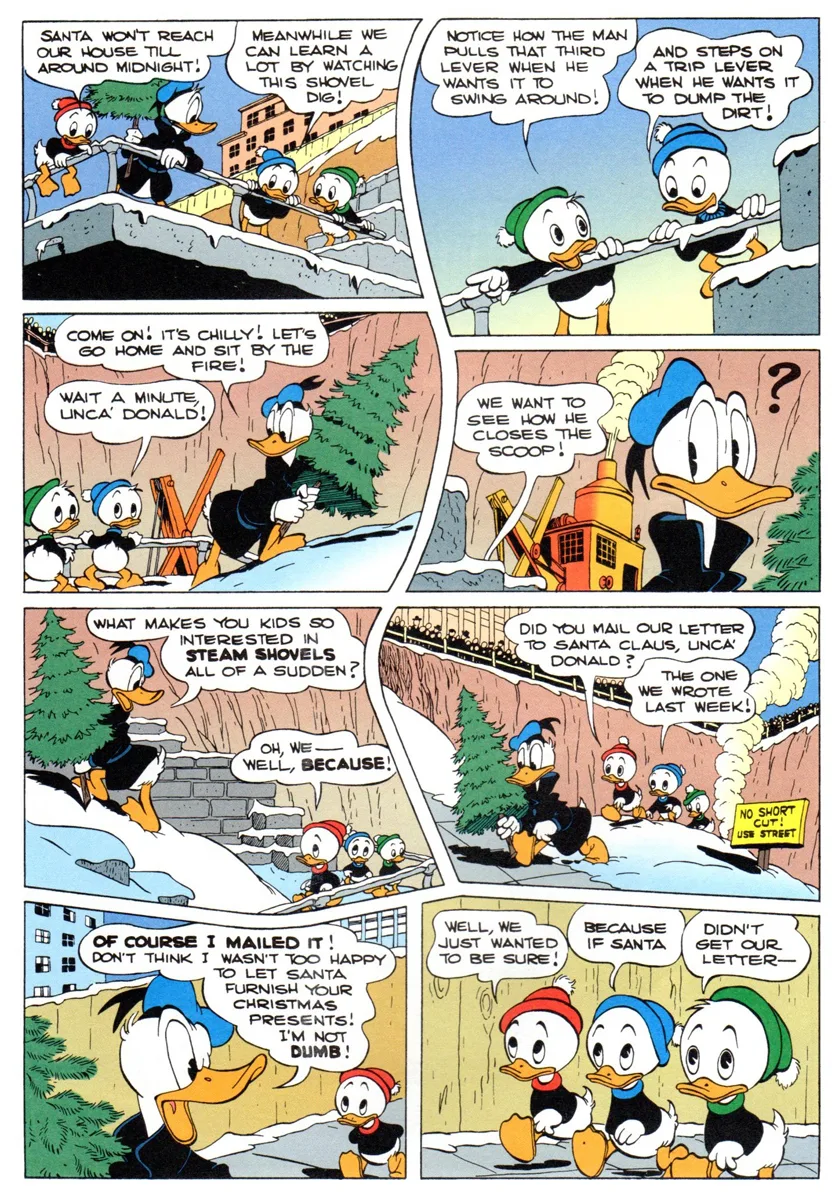
This quest to right a wrong involves competing against Uncle Scrooge, money fights, property damage, a trip to night court, dressing up as Santa Claus, and much more. Carl Barks, a master of economical storytelling, manages to squeeze all of it into 24 pages. The legendary cartoonist can do this by implementing, with a few exceptions, 7-8 panels per page. So while scenarios may only last a page or two, they don’t feel lacking, as plenty has happened on the page. It’s a stark contrast to modern storytelling, where this kind of story would likely be stretched out to accommodate all the ideas or elements removed to fit the page limit.
I discussed A Christmas For Shacktown, another Carl Barks Christmas gem, this time last year. In this, I noted that it’s a tale with the thesis that “altruism is far more rewarding than the material matters of Christmas”. The frenzied Letter to Santa is not as philosophical, but it does have a message about gifting for the right reason. Donald’s gift quest, while tinted by some guilt, is driven by wanting to make his nephews’ Christmas wish come true. Uncle Scrooge, on the other hand, is all about the glory. Barks smashes these two motivations against each other, often literally, until the final pages. It’s here where readers remember that gifting is about bringing joy, something Uncle Scrooge doesn’t quite learn in the story’s final punchline.

So, how chaotic is this story? Very, as the previous paragraphs have alluded to. But before the mayhem reigns supreme, Barks sets up an initial sense of calm. The page before Donald’s realisation features a soft wave down the middle created from the negative space of the panel gutter. However, that will be the last we see of these smooth page layouts. From there, the panels become more asymmetric and varied in shape, almost like pieces of shattered glass placed on the page. These shapes match the energy of the subject within them, whether it be Donald hitting Scrooge over the head with a sack of money like an Attitude Era chair shot or the two fighting in the street with steam shovels with blows on par with a heavyweight boxer. These elements drive the first half of the story before it shifts into a more sitcom-style farce. While this segment is not as tumultuous, the fast pace and Bark’s charismatic cartooning drive it towards its conclusion and back to a sense of calm again.
Donald Duck’s simple mistake snowballs into a chaotic Christmas in Letter to Santa. It’s a tale of wild scenarios, brimming with energy, that could only come from the legendary Disney cartoonist Carl Barks. The result is an extremely fun story that will have you making sure you check your to-do list twice.
Fantagraphics has reprinted Letter to Santa in Donald Duck: Trail of the Unicorn. However, it has been reprinted numerous times, which you can find out more about here. These can be found at all good comic book shops, online retailers, eBay, and Amazon.


Leave a comment