

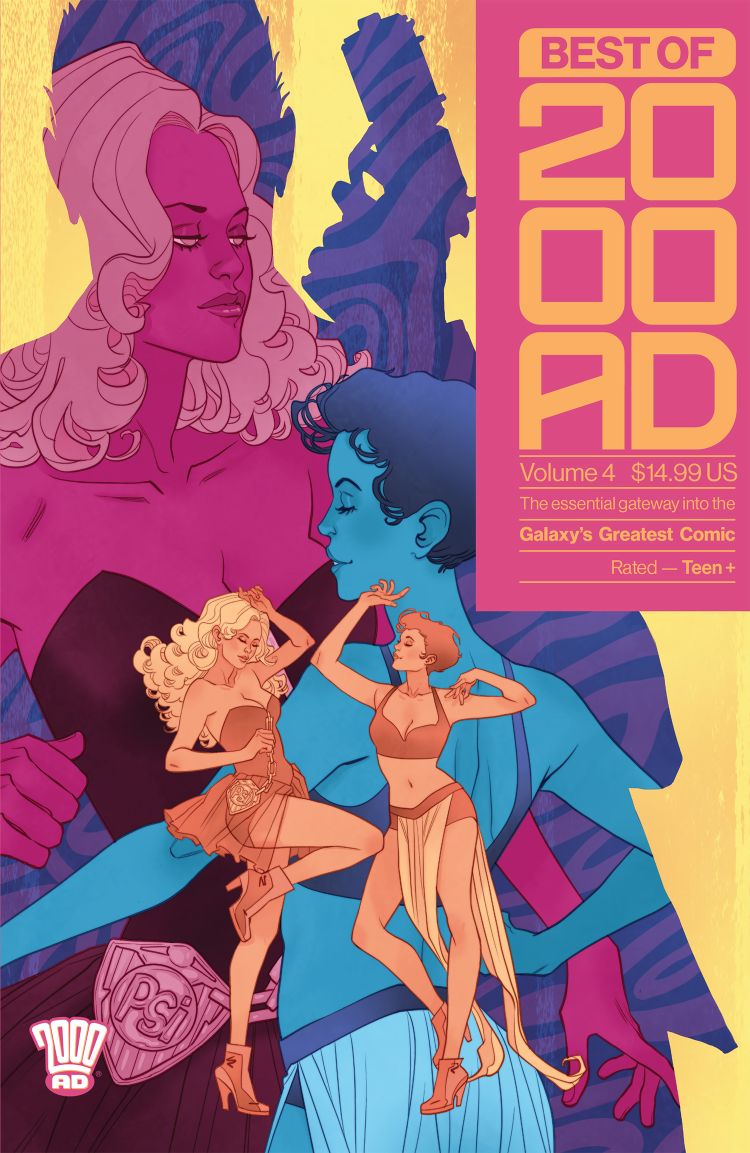
Rebellion has published multiple volumes of Best of 2000 AD over the last 13 months. As you can gather from the name, these are collections of some of the best strips from the legendary British science fiction anthology 2000 AD. Choosing from 45 years worth of material, these 200-page collections are packed with awesome comics. The first three have offered readers a mix of classic strips and fan favourites by creators who’ve made waves across the pond and a few that might be new to some.
Best of 2000 AD Volume 4 hit shelves last week, making it an opportune time to see if it’s another excellent entry point. As with previous volumes, I’ve recruited someone who has never read 2000 AD. Writer and regular contributor to the site Zac Owens joins me to discover if this volume is good for new readers.
Trevor: Hi Zac, thanks for joining me. Before we dive into the guts of this collection, what’s your experience with 2000 AD?
Zac: Zero experience at all. I know that Judge Dredd is… a character who… judges things? I know a lot of my favourite comics creators started at 2000 AD, like Grant Morrison, Alan Moore, and others. But I have never read a page of their comics. I’ve been meaning to for a long time.
Trevor: You’re in for a treat! Let’s jump into it.
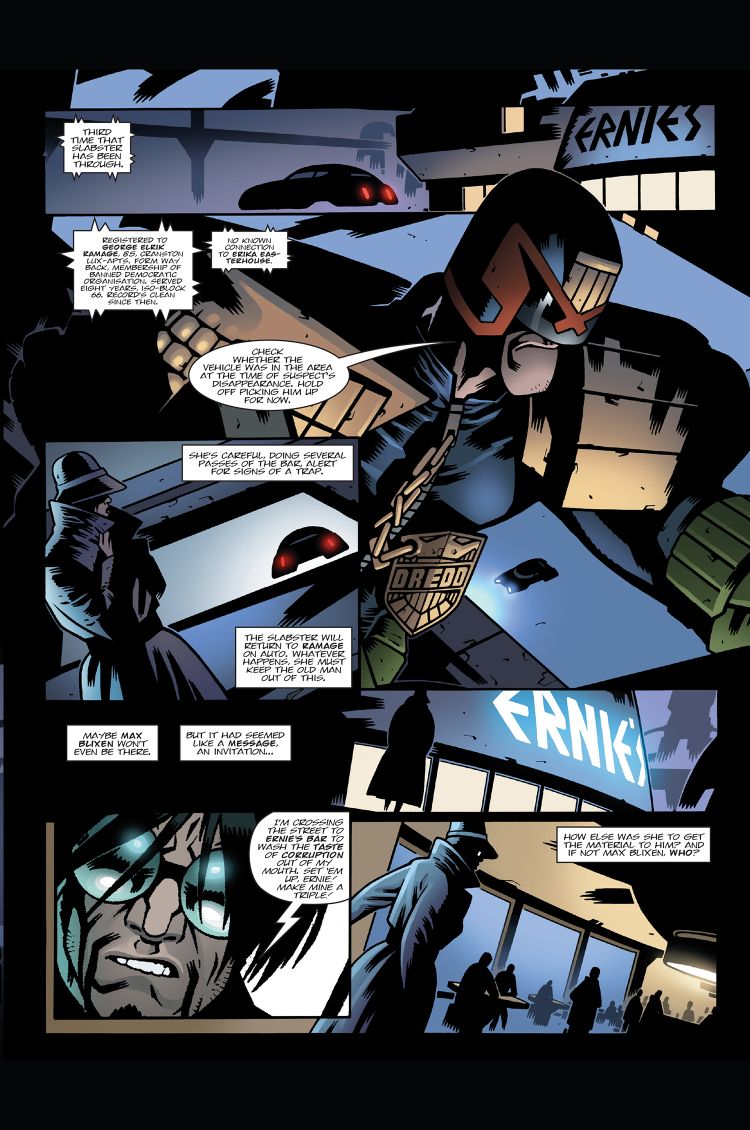
Judge Dredd: Mega-City Confidential
Written by John Wagner. Art by Colin MacNeil. Coloured by Chris Blythe. Lettered by Annie Parkhouse.
Trevor: Here, we’ve got the first of two Judge Dredd stories. How was your first experience with the character?
Zac: I’m not going to lie, I found this story a little on the text-heavy side. The basic idea of it – someone finding dirt on the Judges and trying to get that story to the press – was interesting, but the execution felt a little belabored.
My understanding is this came out in 5 parts, which might explain part of why it’s harder to read in one go.
Trevor: I can see what you mean. The themes of Mega-City Confidential lead to a more talk-heavy story – especially when you compare it to the other Judge Dredd story in this collection. I was okay with it as it was only 30 pages.
Yeah, this was serialised weekly in five parts of six pages each. A more talky serial like this probably doesn’t benefit from this form of publishing in the same way as other Judge Dredd stories as there’s a lot of information that needs to be relayed in a short period of time.
Zac: I think it also didn’t help my experience that I don’t know Judge Dredd. There’s an aspect to this story where it feels like Dredd is really supposed to have a presence. People shiver when they see him. But in the story itself, he doesn’t do all that much to make you fear him. So those scenes where he shows up didn’t have as much of a punch for me as a new reader.
Trevor: From a thematic standpoint, it’s certainly an interesting story exploring whistleblowing and surveillance. The story was published in early 2014 and was clearly inspired by the news of recent years e.g. WikiLeaks, Julian Assange, Chelsea Manning, and Edward Snowden.
Zac: It’s definitely interesting to set very realistic themes in a world that’s heightened and satirical. In many ways, Mega City didn’t feel all that outside of the realm of possibility. I’m not sure if that hurt or helped the story. At times, it felt like they could have pushed the satire a little further than they did. But that might actually be more an issue of it feeling more dated now. We’re all a little bit more cynical than we were in 2014, so dystopian satire starts to look almost boringly naturalistic. (I promise I’m not always such a downer!)
Trevor: I get what you mean. The satire is much more grounded in this story when compared to other Judge Dredd stories, some of which go in wild and extreme directions.
Zac: I think that’s been my general impression of Judge Dredd, so I spent a lot of this story waiting for the penny to drop.
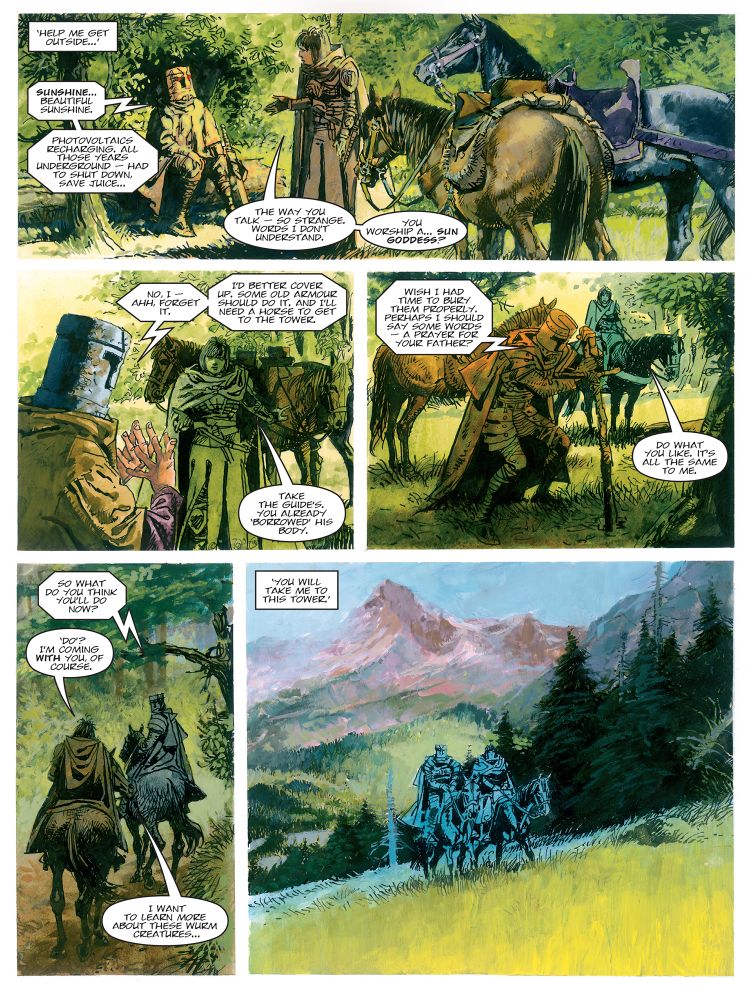
The Order
Written by KEK-W. Art by John Burns. Lettered by Annie Parkhouse.
Trevor: Up next is The Order. Where the Judge Dredd serial might be better read week-to-week, this one reads quite well all at once. It starts off slow, revealing pieces of itself as it goes but it really picks up steam by the halfway point and powers ahead to the conclusion. Because of this, it’s also a story that I had to redefine in my mind based on what I thought it was versus what it ended up being once the action started in earnest.
Zac: I totally see what you mean by that. I think it starts off quite grounded, yet joyfully ridiculous at the same time. You start off in a medieval landscape and then the next thing you know, there’s a robot and some werewolves. But by the end, it’s dealing with such big concepts that it starts to make very little sense. Not in a bad way, though. It’s aware of and celebrates its own wildness. Feels almost like a Grant Morrison story to me by its conclusion, like this was the kind of dialogue you could find in Final Crisis or Multiversity or something.
Trevor: I don’t mind that it doesn’t make a lot of sense. It feels like details were intentionally held back so as not to ruin the momentum. There are seven additional story arcs, so I’m assuming lore and explanation is expanded up on those subsequent tales.
John Burns’ art is phenomenal. He’s been making comics since the 1950s and only just announced his retirement recently. The linework is in the British tradition of the 50s-70s but it’s elevated through the colours.
Zac: I was just going to say how hypnotized I was by the art. The comics world is going to be a darker place without Burns making new work, but now I know I need to dive into more of his stuff. There is also so much movement to each panel. There are scenes where someone has been shot in the head or something, and you see the explosion of blood in one place, but their whole body has been thrown several feet away by the impact. Such a cool effect. And the colours have so much versatility to them. No one scene looks like another.
Trevor: Oh yeah, the colours are so rich. I like how they can be used to set the tone of a scene. Some battles are washed in a greenish-orange as they battle the wurms or the blueish hues of flashbacks. It reminds me a lot of the smart colouring that could be seen when watercolours became more prevalent in the 1980s.
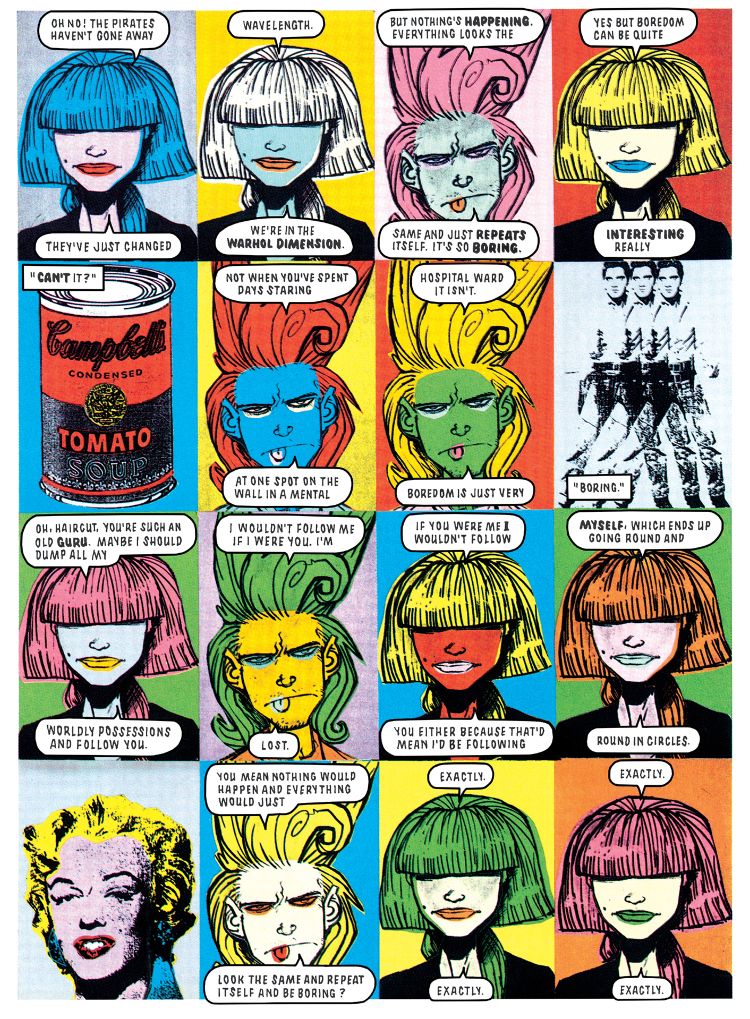
Hewligan’s Haircut
Written by Peter Milligan. Art by Jamie Hewlett. Lettered by Tom Frame.
Trevor: Time for the headliner of the collection, Hewligan’s Haircut. There’s a lot to unpack with this one. Where do you want to start?
Zac: “If you can act or pretend you’re sane, you are sane.” I mean, this had me from the first page. Milligan’s a name I recognized from the outset. I love his work, and this was just another reminder of why.
I find it so interesting to think about the balance of nonsense and sense in a work. Some people take it too far, and you find yourself just ticked off that you’re wasting your time with something that almost feels lazily strange. Others get the balance right. I think of Lewis Carroll, Grant Morrison again (their Doom Patrol which was coming out around the same time feels like a huge influence here) or even someone like Bob Dylan. Hewligan’s Haircut absolutely gets the balance right. It’s entertaining, odd, but surprisingly succinct at times. Milligan and Hewlett are pitch perfect.
Trevor: I agree, the weirdness never falls flat. Milligan’s script is solid but Hewlett’s art is the glue that holds it all together and sells the weirdness. I’m sure other artists could draw a group of policemen breaking the world record for the most people balancing on a push bike but would they do it with the same animated energy?
At this stage in his career he’s been making expressive art in the pages of Tank Girl, but this feels like a level-up. He’s been given an avenue to to go all out and has taken advantage of it. The second chapter is a great example of this, where Hewligan experiences all the weirdness for the first time. Later on, we get some wild compositions, such as when Hewligan and Scarlet are being chased by the planes.
Zac: Hewlett cuts loose for this. It’s not just the way he sets up pages, or the looseness of his character designs, but even the little details of jokes sketched into the background. You get lots of little notes on T-shirts or on bulletin boards and stuff. I’ll also say, I adored his pages about cubism and Warhol. Even the horse being called Dada, you can see just how much this creative team is deeply influenced by and even perplexed by “high art.”
I’m a huge Warhol fan and I still found myself laughing at how much they made fun of him. Loved it. I think that Milligan’s script having hints at an actual logic here and there – even just the theme of being slightly out of tune with the world – gave Hewlett license to just go wild.
Trevor: I loved the cubism and Warhol pages too. They played around with style and form in a way that made sense to the story and got some great gags out of it too. I don’t mind that they took the piss out of Warhol either, but that’s probably because I tried to read his autobiography and hated it.
Looking at Hewlett on a more macro level, Hewligan’s Haircut feels like a bit of a turning point. The Tank Girl stories that he worked on after this strip are far more experimental. He’s playing with what a comics page can do and finding new ways to express weird and wonderful ideas. While he might’ve gotten to that point eventually, I feel like Hewligan’s Haircut supercharged him.
It’s a shame that he no longer does comics anymore, instead hanging out with Damon Albarn to be the visual side of Gorillaz.
Zac: I knew I recognized his style from somewhere! I’d seen a few pages of Tank Girl here and there, but the Gorillaz is where it clicks. He really needs to get back into comics. We need him! Also, the colours in Hewligan being connected to madness, and the black and white representing normalcy – everything about this story sings.
D.R. & Quinch’s Incredibly Excruciating Agony Page
Written by Jamie Delano & Alan Davis. Art by Alan Davis. Inked and coloured by Mark Farmer. Lettered by Jack Potter.
Trevor: Each of the Best of 2000 AD volumes has included a D.R. & Quinch’s Agony Page. This one especially captures the anarchic nature of the strip, involving them flying a hotrod-like flying car straight into the Pentagon. It doesn’t pull any punches.
Zac: These two are Alan Moore and Alan Davis creations aren’t they? I’d heard a little about them but I didn’t realize they only pop up for a page at a time. I was expecting a full story about them.
Trevor: Oh, there are a handful of longer stories by Moore and Davis. These were published after Moore had left 2000 AD to focus more on working in the United States.
Zac: I think these one-pagers benefit from a familiarity with the characters. There’s so little time to make an impression, and while it certainly does, I wanted more time to discover what D.R. and Quinch are all about.
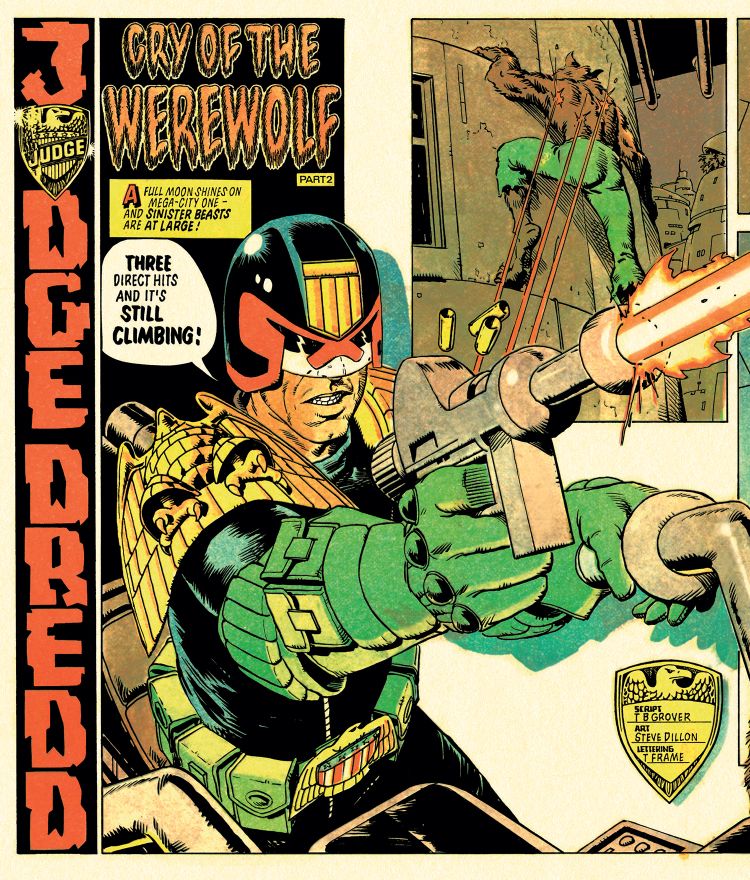
Judge Dredd: Cry of the Werewolf
Written by John Wagner and Alan Grant. Art by Steve Dillon. Lettered Tom Frame.
Trevor: If Mega-City Confidential was too grounded for you, this story swings the pendulum in the other direction. In the first two pages, Judge Dredd states that he’s been on duty for 36 hours and has arrested 300 people today. He then takes a ten-minute break in a special rejuvenation bed so he can jump right back into duty. Oh, and there’s also the tease of werewolves. There are a lot of werewolves in this one.
Zac: This is exactly what I wanted from a Judge Dredd story. Like you mentioned, that initial introduction of him working 36 hours, making 300 arrests and then taking a ten minute nap to recoup is perfectly satirical. Then there’s the first grizzly scene that the judges come upon and a witness who has been horrified by what they discovered. But the judges don’t even connect the dots and just tell them “Calm down, citizen. If you’re innocent, you’ve nothing to worry about!” Such a brilliant little detail of world building and satire. And Steve Dillon! That’s another name I know. He feels like the exact right man for a werewolf Judge Dredd story.
Trevor: Steve Dillon is great in this. Although, you wouldn’t recognise it was him at first glance. This strip from 1983 is informed by much more classic British work of the time instead of his later stuff like Preacher or The Punisher. I like the way he inked the comic. The heavy use of spot-blacks really sets the atmosphere and creates a lot of depth in the art. It’s busy – as most strips are in 2000 AD of the era, although there’s a rare splash page too – but very legible. There’s a lot of black on the page but everything is easy to read.
Zac: So, the way this story plays out is that every first page of a new chapter is in color, then all of the subsequent pages are just black and white. I’m assuming that had more to do with the cost of coloring a page in 1983 than it did with a choice in style, but I still love the effect it has. In many ways, it feels like it gives the story a chance to lean into the Universal monster movie influence. Lon Chaney Jr, eat your heart out!
Trevor: One thing I found amusing about this strip is the number of one-liners Dredd has. They don’t always land, but there’s a sense that Dredd thinks they’re clever. Oddly enough, he can dish them out but can’t tolerate them, scoffing at a scientist for naming a newly developed chemical after himself.
Zac: I was also really amazed by how much world-building this did for me. I’m sure these are probably facets of Mega-City One that have been referenced in other stories, but I was even shocked to find out it was New York City. The little posters of “Rocky 37” and “Mad Max 25” in the background are hilarious. But the “long walk to the Under City” being an option a judge has to end their career, the Under City itself, I found myself so interested in this world. It felt fully fleshed out.
Odd & ends
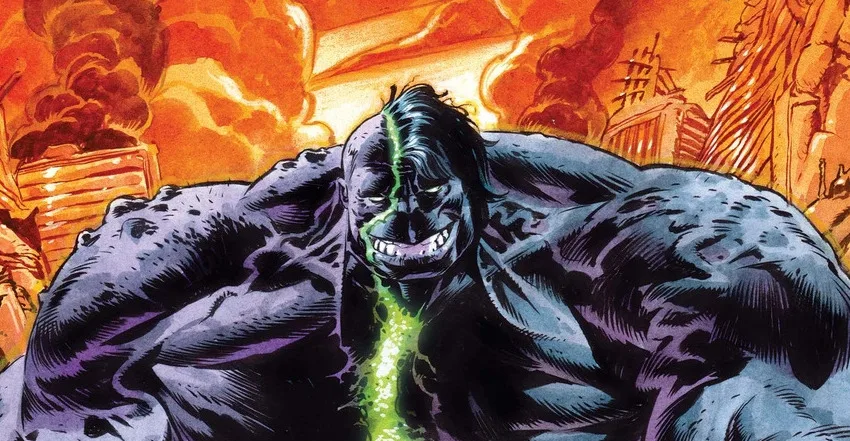
Trevor: For those interested Rebellion just announced the contents of Best of 2000 AD volume 5. It will include Al Ewing and Henry Flint’s Zombo; Dredd spin-off Devlin Waugh by John Smith and Sean Phillips; Missionary Man by Gordon Rennie and Frank Quitely; plus two more Judge Dredd tales. It will hit the shelves in February.
Also, reading Cry of the Werewolf inspired me to watch An American Werewolf in London.
Zac: And we’re in the right time of year for that too! I’ll have to add it to my Spooky Season watchlist, right after The Wolf Man.
There are a ton of creators I recognize in that list for volume 5’s collection, including favourites of mine like Sean Phillips and Frank Quitely. Can’t wait to check that out when it’s released!
The verdict
Trevor: It was another solid volume of Best of 2000 AD for me. Hewligan’s Haircut was definitely the standout. How was your first taste of 2000 AD?
Zac: Not everything was a hit for me. The D.R. & Quinch Agony Page and the first Judge Dredd story both felt a little like I needed more out of them. But overall, this gave me an incredible taste of 2000 AD. There is so much creative energy in these pages. I really want to dive deeper into more 2000 AD stories as a result. I’ve never read comics like this.
Trevor: Success! Another person converted.
The Best of 2000 AD Volume 4 can be found at all good comic book shops, online retailers, eBay, Amazon, and the 2000 AD webshop (print/digital).


Leave a comment