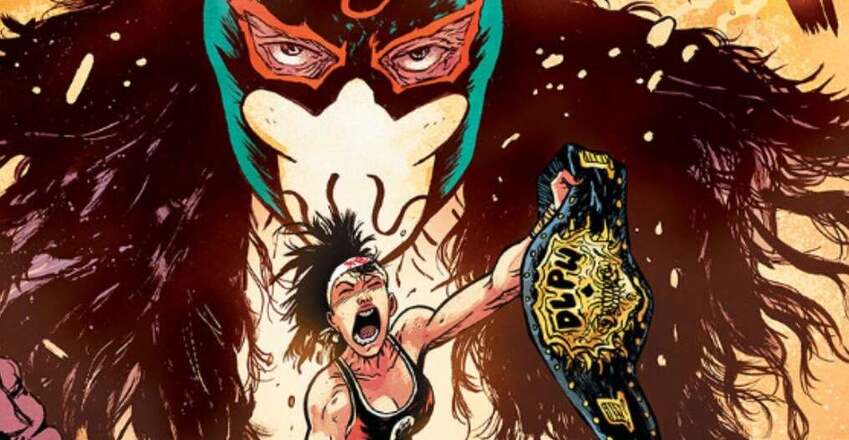

Written and art by Daniel Warren Johnson. Coloured by Mike Spicer. Lettered by Rus Wooton. Published by Image Comics.
Professional wrestling can be a lot of things. Big beefy blokes hitting each other. Feats of impressive athleticism. A violent soap opera. Sports entertainment. However, at the core of all these is one thing – storytelling. It fuels everything in wrestling and gives the larger-than-life characters a reason to be in the ring, whether vying for a championship, settling a grudge, or something more character-driven. It’s what makes wrestling so appealing to so many people. It also makes the sport translatable into other mediums, including comics. Daniel Warren Johnson’s Do A Powerbomb is a recent example of this and one that understands wrestling storytelling potential.
Do A Powerbomb begins in the past, not with our protagonist Lona Steelrose, but with her mother Yua. Here, she’s defending her championship against Cobrasun, a bulking masked wrestler who’s equally as impressive in the squared circle. Unfortunately, the match ends in tragedy when a botched move accidentally kills Yua Steelrose. Lona was in the crowd that night, witnessing the death. It’s an event that stayed with her, driving her to wrestle just like her mother in the present day.

While she has a few matches under her belt, an opportunity arises when she’s invited by a wrestling-obsessed necromancer from another planet to compete in his tournament. The prize is a chance to bring her mother back. However, the catch is she’ll need to tag team with Cobrasun to make it happen.
It’s clear very early on that Daniel Warren Johnson is a wrestling fan. The afterword in the first issue confirms this, where he talks about how he discovered New Japan Pro Wrestling in the summer of 2018. He was drawn to the characters, physical feats, and the energy of it all. It was a pivotal moment for him, where wrestling became a deep passion and integrated into his comics work, including the Wrestletober sketch series, a recent cover featuring wrestlers Danhausen and Brody King, and even his Marvel Comics work.
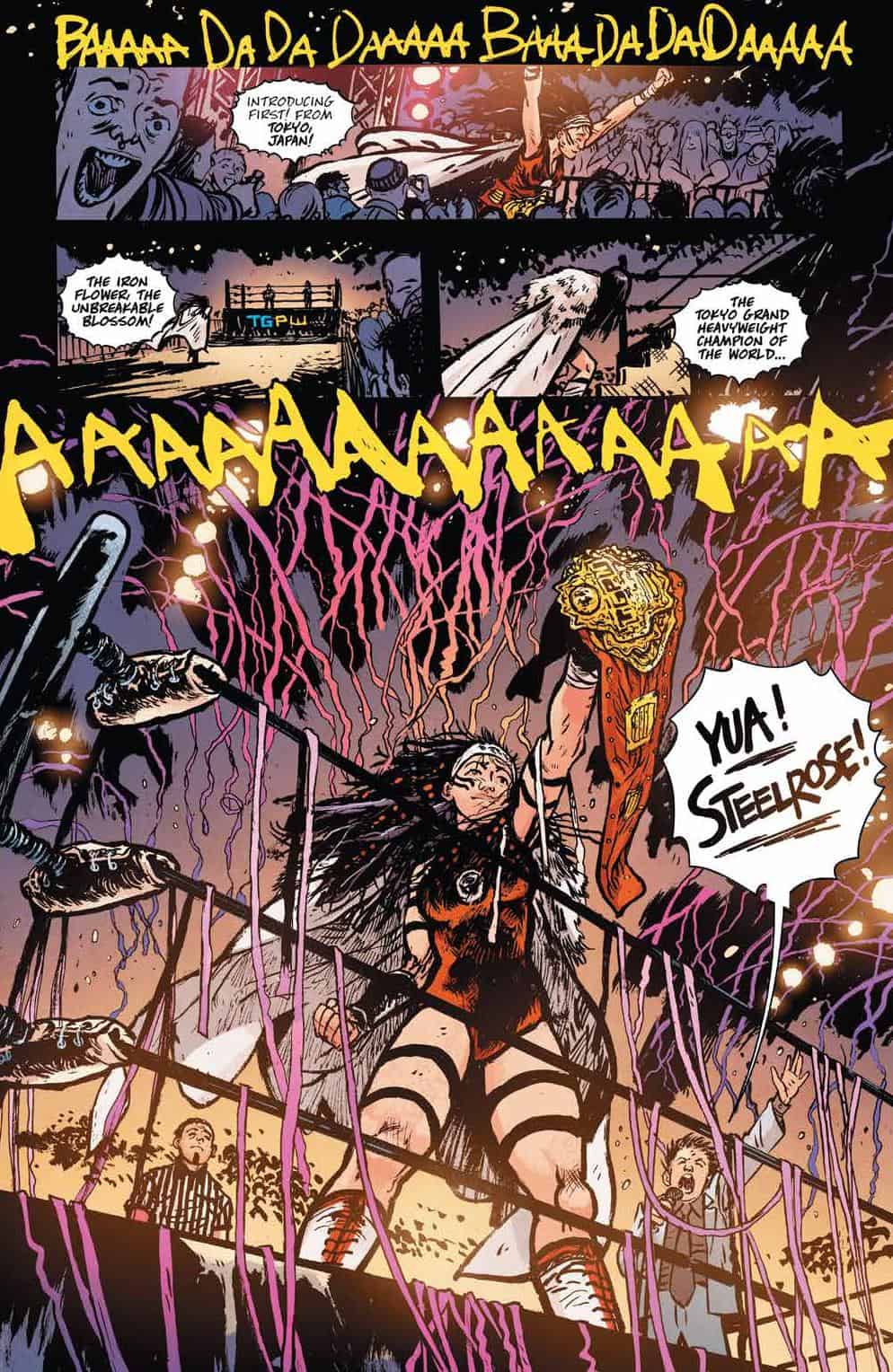
The passion for pro wrestling bursts off the page in Do A Powerbomb. From a storytelling perspective, it hits many wrestling staples, such as vying for a prize, tag teams not cooperating, and how each subsequent opponent our heroes must face is an escalated challenge. These never feel like Daniel Warren Johnson is adding wrestling storytelling tropes for the sake of it and that they’re natural progressions to the story, making it accessible for non-wrestling fans. However, wrestling fans will get a kick out of homages to promotions like NJPW and GCW to big moves like the Falcon Arrow, German Suplex, and Tiger Driver ’97.
Do A Powerbomb intersects the language of comics and wrestling to its advantage. A great example of this is the depiction of one particular near fall. One of our heroes is being pinned with the referee starting the three-count. At the bottom of a page, there’s the 1-count and 2-count. However, the reader has to turn the page to see if the 3-count is successful, eliminating them from the tournament or if they can save themselves from being pinned. The requirement to turn the page builds excitement and anticipation for the reader and turns the result into a surprise.
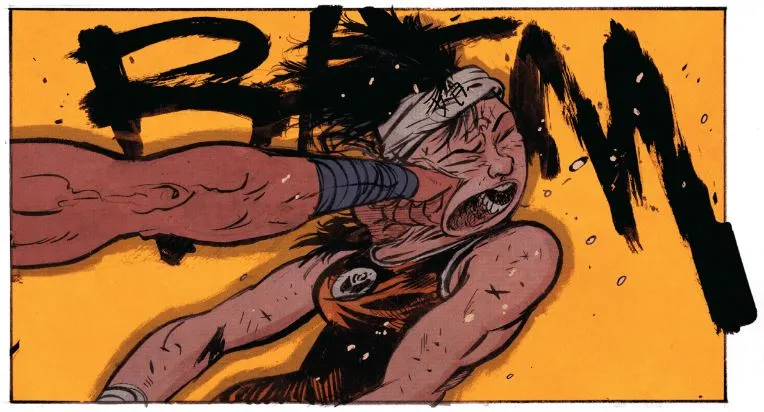
Daniel Warren Johnson has become one of the most exciting comic artists over the past few years for his high-energy style and depiction of action. Do A Powerbomb takes that to the next level, spotlighting pro wrestling at its most visually exciting. Johnson captures the hard-hitting nature of the sport, using squash and stretch techniques during points of impact. A punch is not merely a punch. Its force ripples through the recipient’s body. Other times, especially during big moves, the linework becomes jagged like a seismograph. These make them look extra impressive, highlighting their force, speed, and momentum.
Mike Spicer elevates these moments through the choice use of colour. Not only does he help lift the ink-heavy pages, allowing for great distinction, but he also helps define the mood. Moments in the ring are brightly lit, often using warm colours. This is contrasted by the outside of the ring, where these are darkly lit to reflect many low moments.
These moments are housed in dynamically shaped panels, often slanted to drive the eye across the page and capture the action’s energy. These big moves can often fill the entire panel to highlight their intensity. Other times, a big move can be given the room to breathe by taking up a lot of page real estate. The moonsault off the top rope in the first issue is an example of this, where the size of the panel can call attention to the height of the move, almost freezing time for a moment before getting back into the flurry of the match.
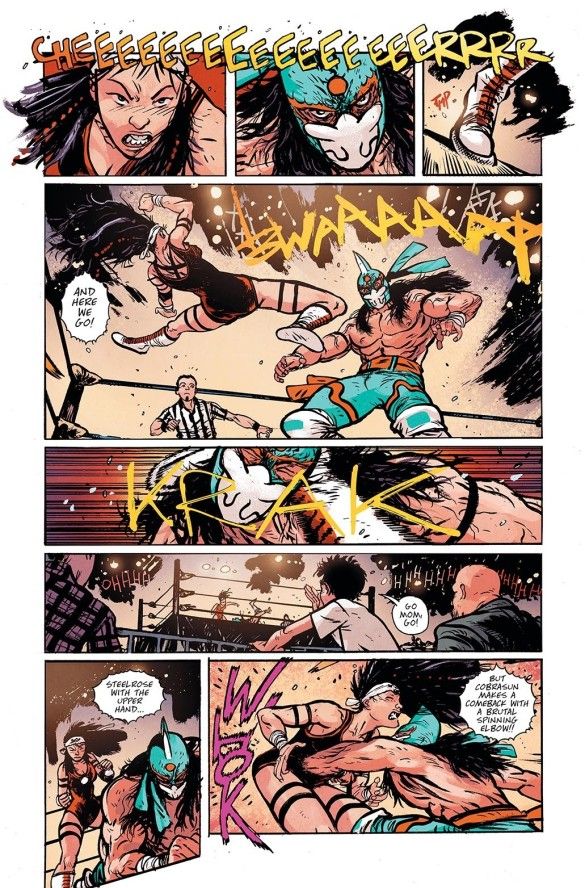
Johnson also bakes the sound effects and stylised commentary into the art. While a talented letterer could collaborate to digitally insert much of them into the art, Do A Powerbomb benefits from the integration as they become an integral part of the composition and capture the energy of a given moment. Letterer Rus Wooton can then focus on the core dialogue, opting for rougher-looking word balloons and a typeface that has a hand-lettered quality. It’s a nice touch that adds a bit of grit to match the hard-hitting world the comic occupies.
Do A Powerbomb understands what makes professional wrestling tick by focusing on storytelling and its energy. Daniel Warren Johnson has captured it masterfully on the page and combined it with impressive action. For these reasons, wrestling fans it’s like reading a five-star match. And for those unfamiliar, it showcases why there are so many passionate fans worldwide.
Do A Powerbomb can be found in all good comic book shops, online retailers, eBay, and Amazon/Kindle.

![How To Start Reading The Old Guard Comic [Guide + Reading Order]](https://www.howtolovecomics.com/wp-content/uploads/2020/07/the-old-guard-feature.jpg)


Leave a comment