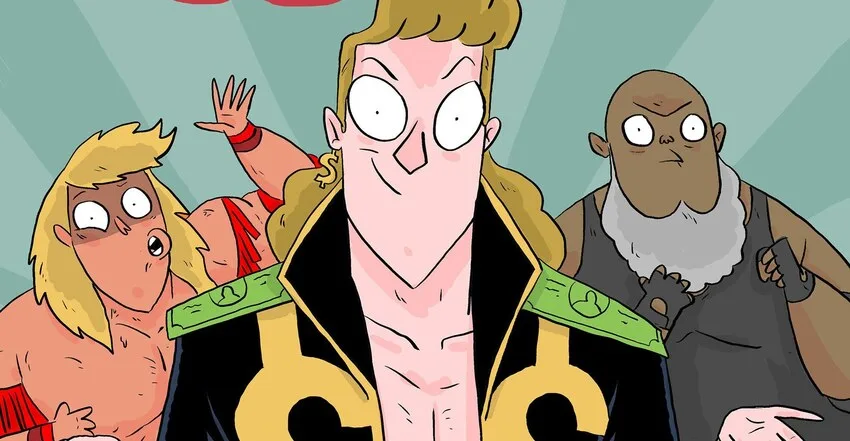

Written by Kyle Starks. Art by Kyle Starks. Coloured by Vladimir Popov. Lettered by Kyle Starks. Designed by Dylan Todd. Published Image Comics.
A part of wrestling fandom, especially if you follow WWE, is advocating for underappreciated wrestlers. Everyone has a favourite who’s brimming with in-ring talent and/or charismatic on the microphone, but is trapped in mid-card purgatory and does not get a chance to shine as a main-eventer. As fans, we want them to succeed, but it seems that someone in management can’t see their potential. Cartoonist Kyle Starks‘ Wrestle Heist comic is an ode to those wrestlers, blended with a revenge-fueled crime caper.
Sterling Steele is the top heel in the wrestling industry. However, he’s one of many wrestlers who have never held the World Championship title. So, despite being respected and liked by his peers – the opposite of his onscreen character – he’s off to a rival promotion to hopefully taste the success he hasn’t found thus far. He’s just got to get through the main event of Fightsgiving 13, where he’ll lose on the way out. Unfortunately, the vengeful promoter doesn’t like that he’ll find success elsewhere and arranges for his opponent to intentionally injure Sterling during the match. A year later, Sterling has mostly recovered from his injury but will no longer wrestle again. As payback, he and other wrestlers that the promoter has wronged plan to rob the promoter during the biggest wrestling event of the year.
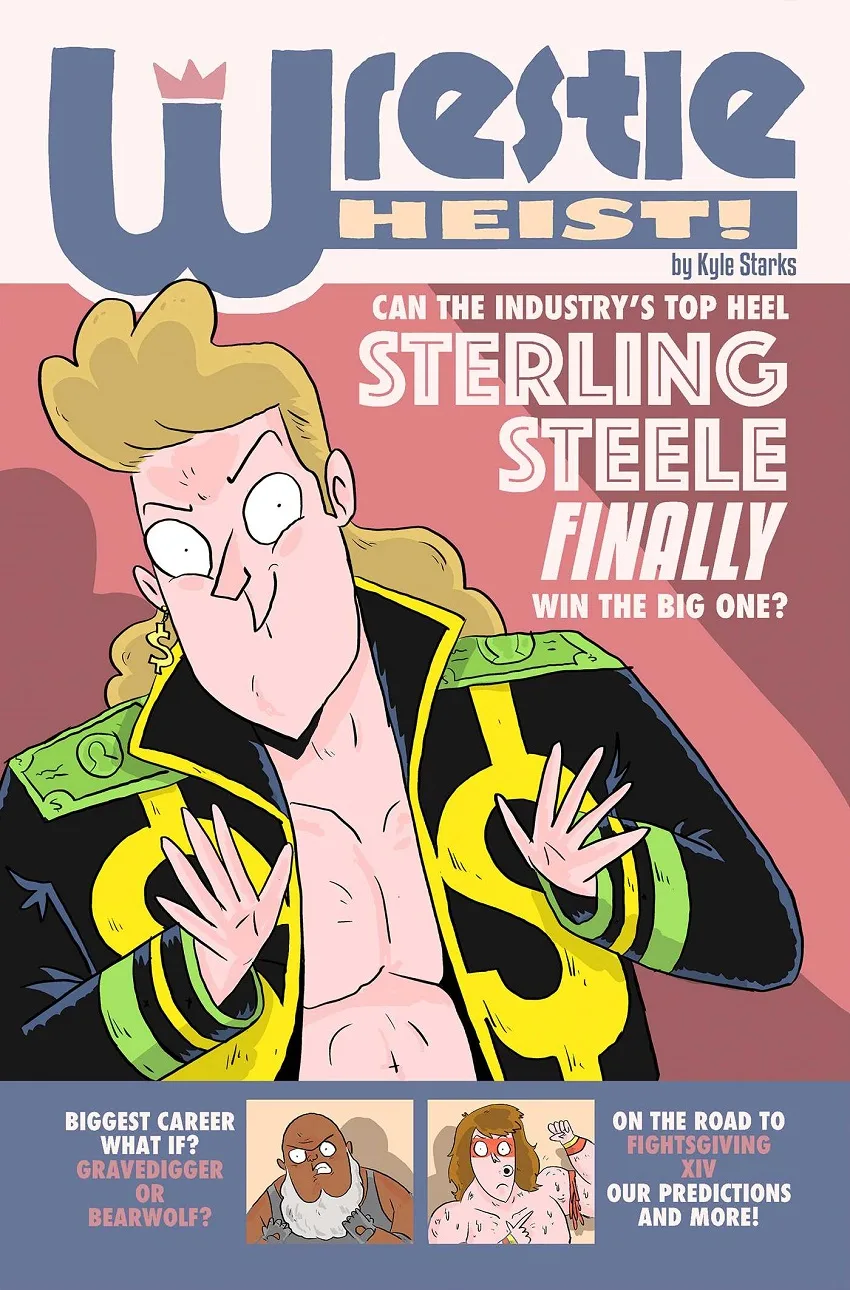
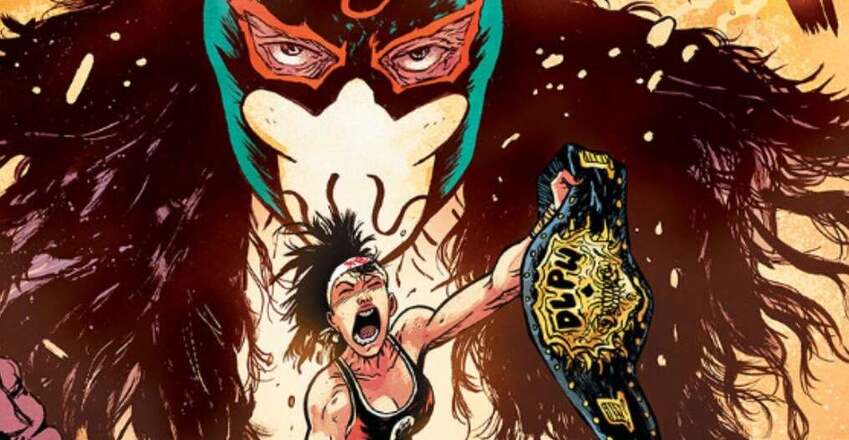
Wrestle Heist goes all in on the wrestling theming. It’s evident even before you open the book, with the covers and interior design modelled off Pro Wrestling Illustrated magazine. Starks inserts plenty of wrestling gags inspired by the classifieds seen in these magazines, along with other editorial-style content, that adds richness to the comic’s world as part of the backmatter. They’re the kind of thing that those nostalgic for analog days of wrestling fandom will get a kick out of. For younger fans or non-wrestling fans, there’s still plenty to appreciate from the dedication to Dylan Todd’s design and the world-building it contains.
Kyle Stark’s passion for wrestling isn’t merely skin-deep. He’s a fan, taking figures and events from wrestling’s past and present to build his characters and story. This can be done in many ways. Daniel Warren Johnson’s Do A Powerbomb! is inspired by the AEW and NJPW style of wrestling. Wrestle Heist, on the other hand, is entrenched in WWE and WCW. While tribal fans may be turned off by this, entrenching it in this school of wrestling works in its favour.
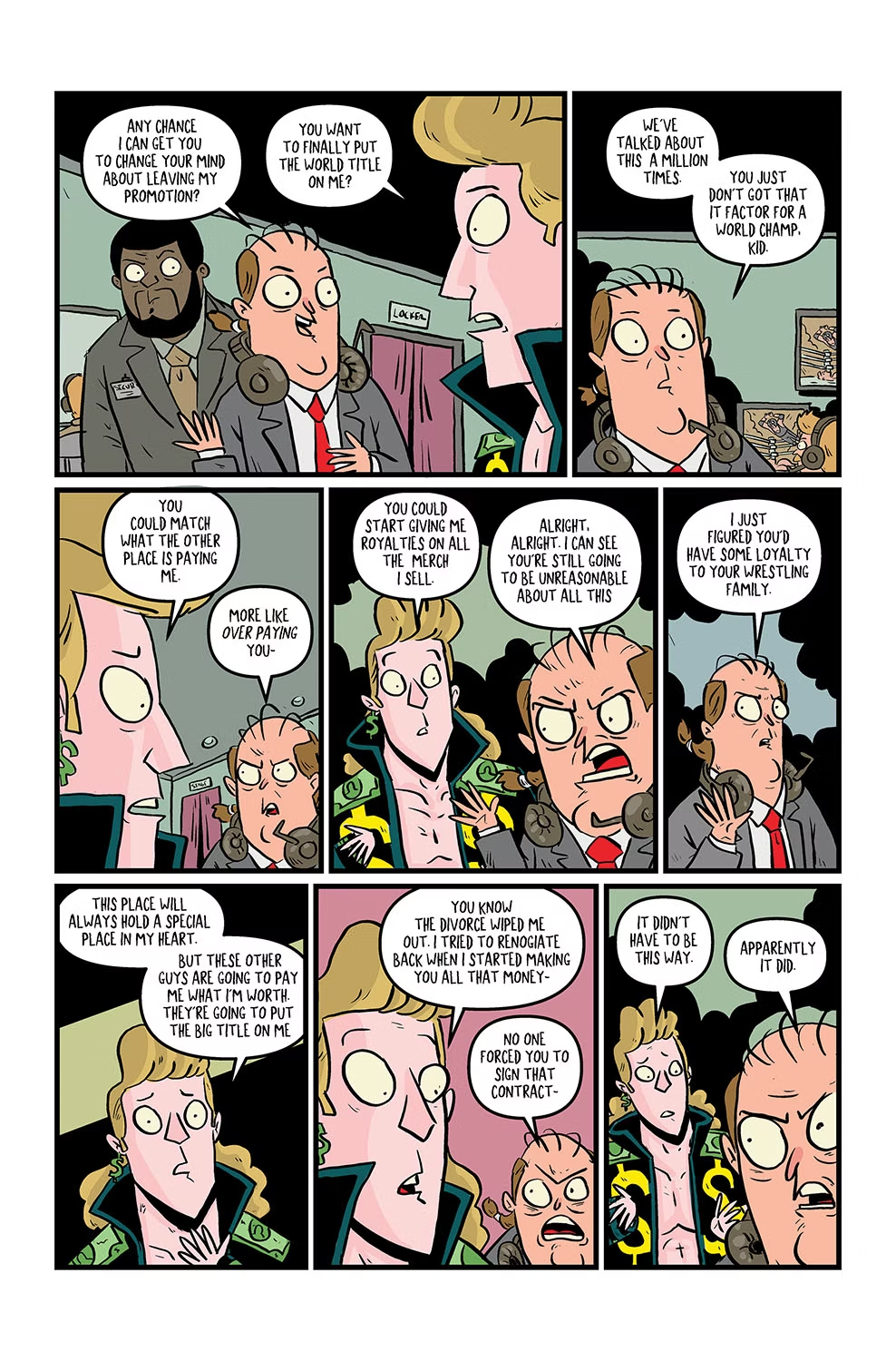
The evil promoter, Buddy Hansen, is inspired by Vince McMahon, with a vengeful attitude that puts money and ego above all else – with the vengeful act described a few paragraphs ago having a hint of the Montreal Screwjob to it. To make Buddy Hansen even more despicable, Starks draws him to resemble heelish promtoter/manager/advocate Paul Heyman. This also goes for the wrestlers. Sterling Steele is inspired by Bret Hart, with other characters inspired by The Undertaker, Ultimate Warrior, Rey Mysterio, and Dominik Mysterio too.
Wrestling fans will get a kick out of pointing out the differences and how the real-life wrestlers inform the fictional ones. Non-wrestling fans can still enjoy these larger-than-life characters as Starks treats them as human beings. They have dreams and ambitions; they’ve been wronged by management; and their skills and positive qualities are undermined for some petty reason or another. This makes these characters easy to sympathise with, making you want to root for them.
So that’s the “Wrestle” part covered. What about the “Heist“? If the wrestling is the theming, then the heist is the through-line of the comic. Readers get all the classic conventions of a heist story. Readers see the crew assembling, the planning stage, and the heist’s execution. Along the way, there’s plenty of twists and turns, unexpected scenarios, and on-the-fly pivots.
While many heist tales include these elements, the wrestling element makes Wrestle Heist stand apart. Not just because of its setting and larger-than-life characters, but because it opens up the door to different character dynamics. There’s the father who’s trying to reconnect with his dirtbag son, begrudging partnerships between co-workers, and the quest for recognition in an industry where people put their bodies on the line every time they step into the limelight.
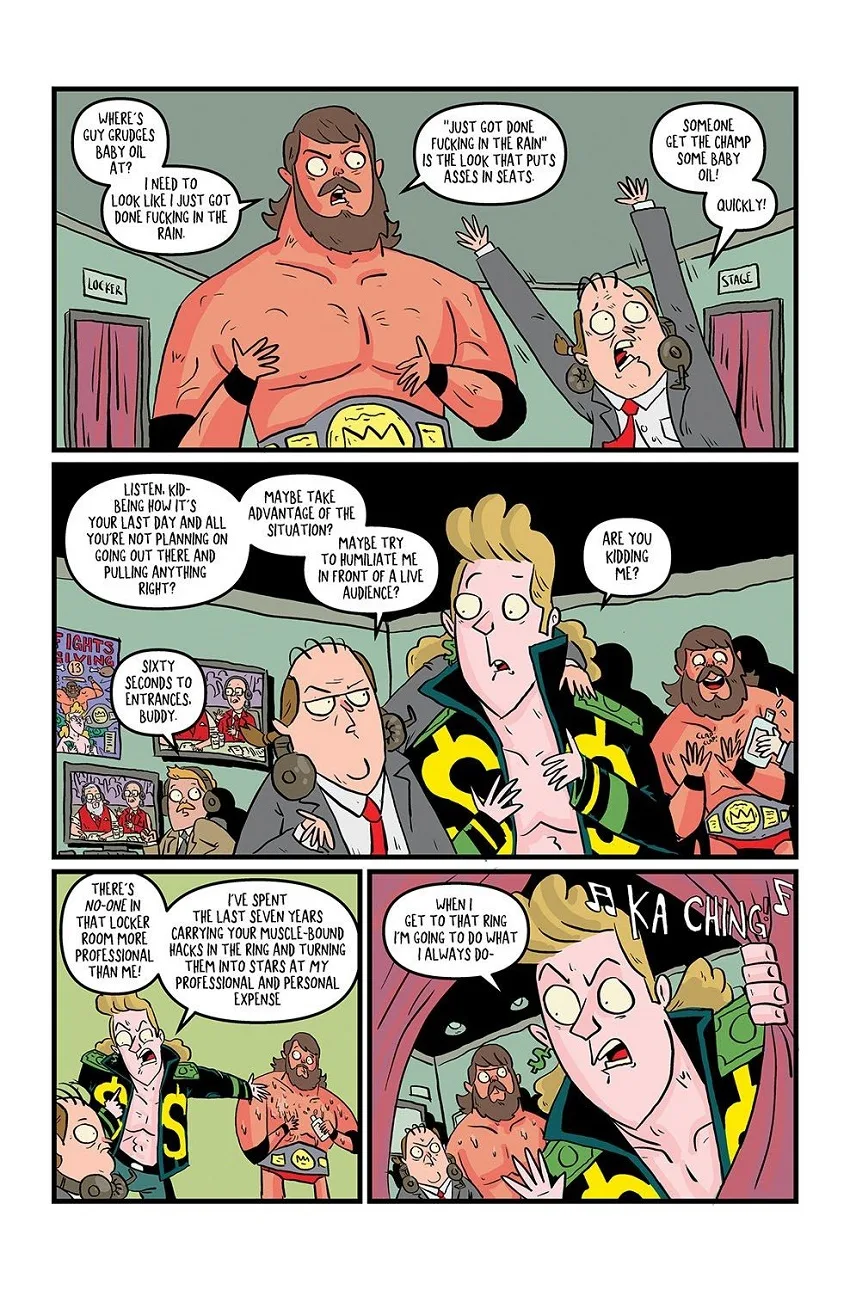
The other part that separates this comic from other heist stories is the humour, driven by Starks’ cartooning. He draws expressive characters, with animated body language and wide eyes that speak volumes in every panel, amplifying the humorous dialogue. It’s particularly noticeable with the Ultimate Warrior-inspired character, who has similar energy to the real-life counterpart to the point that it’s part of the joke – if you know, you know. It also makes the wrestling elements feel bigger, with colour artist Vladimir Popov using colour to create impact, such as a panel bathed in red when a dangerous piledriver is performed.
Wrestle Heist is a human story, full of humour, twists, turns, and larger-than-life characters. The wrestling aspect separates it from other heist stories. As a result, it hits that sweet spot between homage wrestling fans will enjoy and fresh elements that will interest non-fans, leading to a phenomenal read.
Wrestle Heist was serialised in Wrestle Heist #1-5 and is now collected in trade paperback. It can be found in all good comic book shops, online retailers, eBay, and Amazon/Kindle.


Leave a comment