

Almost 80 years ago, Jerry Siegel and Joe Shuster revealed Superman’s origins to the world. Its structure is both simple and multi-layered. DC Comics has revisited it to tell a new version of the origin that reflects the storytelling methods and expectations of readers of the time. As a testament to how timeless it is, the broad strokes of the origin have remained untouched throughout the years.
So, what is Superman’s origin story?
While Superman’s origin has been told numerous times, its basic form the origin is:
It all starts on Krypton, a planet with an advanced culture but is also doomed to be imminently destroyed. Before it can be destroyed scientist Jor-El and his wife Kara are able to send their son off into a rocket to escape the destruction. The rocket eventually makes its way to Earth where it crashes down in Smallville, Kansas, where it’s found by The Kents.
The Kents decide to keep the baby and raise it as their own. As the child, which they named Clark, grows up they notice that he exhibits some extraordinary gifts and realise that the child is something special. With their love and guidance, the Kents shape Clark’s moral code and teach him that he is to use his gifts to help humanity.
Once Clark reaches his adult years he moves to Metropolis where he lives a double life. In one life he’s the mild-mannered Clark Kent, who works as a reporter at the Daily Planet newspaper. In the other, he’s Superman, who uses his immense abilities to do good in the world.

How has Superman’s origin evolved over the years?
While it was brief, Jerry Seigel and Joe Shuster detailed Superman’s origins in 1938’s Action Comics #1 – the same comic he debuted in. In just one page it told the familiar tale albeit with many details missing. It mentioned that he came from a doomed planet, that he was found by passing motorists, and that he developed fantastic strength.
In 1939’s Superman #1, the origin was told again, but this time fleshed out over two pages. Apart from one panel that mentioned Clark was initially turned over to an “orphan asylum,” this pair of pages sets up the core foundations upon which future stories are built.

Superman’s origin has been expanded upon to make it feel fresh and with the times. Throughout the Golden and Silver Ages, the origin was revisited from time to time. Those two pages of origins became full-length stories – as detailed in Superman (1939 series) #53 and Superman (1939 series) #146 to name a few. Scenes that were originally a single panel were fleshed out. For instance, we discovered more about the how and why of Krypton’s destruction and about Clark Kent’s younger years.
The Golden and Silver Ages had created a significant amount of bloat to the Superman mythos. There was an array of superpowered pets, varieties of kryptonite, and it was established that Superman operated as a hero as a boy (aka Superboy) instead of starting as an adult. While these were all fine at one time, they began feeling dated once the more mature 1980s rolled around.
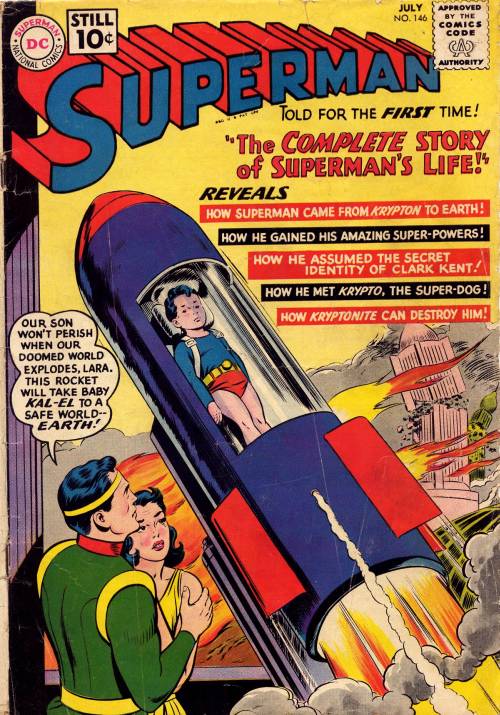
Golden and Silver Age storytelling also presented DC Comics with another issue. Stories would contradict themselves and it became a mess trying to tie everything together. The solution at the time was to use the multiverse as a fallback for explaining these continuity errors. Editors explained a contradiction away by saying the story was either an “imaginary story” or happened in a parallel universe. The problem is the more this trick was implemented the messier and confusing it became.
By the mid-80s this issue was getting way out of hand. The solution was the Multiverse shattering Crisis On Infinite Earths, which acted as a cosmic Spring clean for DC’s multiverse. Where there were infinite parallel universes stood only one. There was one of every hero – including Superman.

This reorganisation was a clean slate for DC and with that many of their heroes received new origins. These honoured the past but aligned with the times to feel fresh. As a result, Frank Miller and David Mazzucchelli crafted Batman: Year One, George Perez took on Wonder Woman, and John Byrne (who had jumped ship from Marvel) was tasked with Superman.

To kickstart his Superman run, Byrne would revisit the Superman origin with the six-part miniseries Superman: The Man Of Steel. It took away much of the baggage that previous eras had accrued and favoured contemporary ideas. As a result, we see more moments with The Kents, who play a big part in grounding Superman in humanity. We also see more of Superman’s early days as a hero. This includes his early encounters with Lex Luthor and even his first team-up with Batman. (Stories like Superman For All Seasons and Man and Superman would flesh out this period further.)
Byrne’s interpretation of the origin remained gospel for many years until DC decided that the origin needed a 21st-century touch in 2003. Thus the twelve-part maxiseries called Superman: Birthright was born. Written by Mark Waid and art by up-and-comer Lenil Francis Yu, the comic took what Byrne had established and expanded on it. It didn’t retread what Byrne had done before, but filled in gaps and treated Byrne’s interpretation as events that happened off the page as a way to not negate them.

Where The Man Of Steel had left gaps in time, Birthright fills these in with additional moments that add to the origin. The most notable of these were the years in which Clark travels the world being a journalist, while at the same time trying to find his place in the world. In his travels, Clark finds purpose and inspires him to become the hero we know and love.
Birthright’s most controversial change to the origin revolves around Clark Kent’s relationship with Lex Luthor. It takes a page out of the popular Smallville TV series, which at the time was roughly three seasons into its ten-year tenure, and establishes that Kent and Luthor were friends in their teenage years.

Remember when I said DC jettisoned many of the cheesier elements of Superman’s mythos? Some of them would find a home again with Superman: Secret Origin by Geoff Johns and Gary Frank. The pair took Superman’s origin and injected it with elements that disappeared from the Post-Crisis era. Johns intentionally reintroduced these elements in a way that gave them some modern context to modern readers but still felt classic. For example, Superman was Superboy in his younger years, he had adventures with the Legion of Superheroes, and brought Krypto, Superman’s Kryptonian dog, into the cannon.
So, which Superman origin should I read?
If you’re looking to read just one Superman origin, then I can highly recommend Superman: Birthright.
Man of Steel is great but being over 30 years old means that it’s a product of another era. Readers who are not familiar with older comics might find it a bit jarring when compared to modern ones. The same goes for any of the origins that predate it. Secret Origin is also great, but it’s a more rewarding read if you have an expanded knowledge of Superman’s mythos.
Birthright is the Superman origin for a 21st-century audience, and as a result, it feels fresh but familiar. It succeeds in its mission and 15 years on is still doing so.
Final words
It’s with this strong foundation that Superman’s origin has not only lasted as long as it has, but it has been able to be so malleable with the ages. It truly is a testament to the imagination of Superman’s creators Jerry Seigel and Joe Shuster who were able to create something so lasting. As a result, Superman’s origin is one of the best origins in the DC Universe – perhaps even the best in comics.
Have your say!
Do you like the Superman origin? Do you have a favourite telling of it? Share your thoughts in the comments below or via Bluesky, Facebook, X, or Mastodon.


great story I have ever read
i like it so much thank you
i love this article it captures superman’s true backstory
dont care
Mr.Trevor
For knowing a character can I just read it’s should read or best stories? I mean don’t reading ongoing series. plz reply
Hey Twisto, there are plenty of classic Superman stories that you can read if you’re not interested in the current ongoing series. Here are the Superman stories I highly recommend.
Thank you for this perfect article.
Have a nice life !
Great write-up, Trevor! Thanks for including a recommendation, too.
Also, Gary Frank is terrible at drawing dog faces.
Thanks, Jason! I’m glad you enjoyed it. With it being Superman’s 80th Anniversary there will be plenty of other articles like it.